







There are objects that are not meant to fill a space. They are meant to slow it down.
A flower picked during a walk. An olive branch entering through the window with the morning light. A leaf bent by the wind. Sometimes, this is all it takes to transform a room.
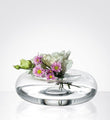
It is from this idea that Tonk was born: a handcrafted glass vase that invites us to observe the essential beauty of things.
More than a container, Tonk is a gesture. A small object of Italian glass design that celebrates simplicity, presence, and the quiet poetry of nature.
The Art of Bringing Flowers to Life: Understanding Ikebana
In Japanese tradition, there is a discipline that has taught people to see nature differently for centuries: ikebana.
The word literally means “bringing flowers to life” and embodies a philosophy that goes far beyond decoration. In ikebana, what matters is not abundance, but the relationship between the flower, the space, the light, and time itself.
Unlike Western floral arrangements, often rich and generous, ikebana seeks balance, silence, and essentiality. Every stem is carefully selected. Every angle has meaning. Even emptiness becomes part of the composition.
Today, this philosophy continues to inspire contemporary designers and makers, giving rise to objects such as the modern ikebana vase, where a single stem can express an entire landscape.
Tonk: An Ikebana Vase for Contemporary Living
Traditional ikebana arrangements use a kenzan, a metal support hidden beneath the water to hold stems in place.
Tonk reinterprets this principle.
Here, the support does not disappear. It becomes part of the design.
The flower emerges directly from the center of the glass, as if it were growing from the material itself.
Transparency meets sculptural form. The stem is not simply placed inside a vase—it is welcomed, supported, and elevated.
A single flower becomes enough.
A daisy gathered in the countryside. A small olive branch. A wildflower discovered along a path.
Tonk is an ikebana vase designed for those who appreciate the beauty of a minimalist floral arrangement and the quiet elegance of intentional living.
Italian Glass Design That Captures Light
Crafted from a solid glass rod measuring three centimeters in diameter, Tonk transforms material into presence.
The result resembles a stone polished by water and time: compact yet visually powerful, capable of capturing light and reflecting it through soft, deep transparencies. At its center, a simple opening welcomes a flower like a natural spring.
This is the essence of Italian glass design: the ability to transform a simple material into an emotional and timeless object.
Tonk does not dominate a space.
It accompanies it.
A Contemporary Home Décor Object for Mindful Interiors
In the Blueside vision, the home is a place of aesthetic exploration, calm, and lived beauty.
Not a perfect or staged environment, but a luminous space filled with books, flowers, natural materials, and meaningful objects.
Within this context, Tonk finds its natural place.
On a shelf beside a stack of books.
Near a turntable while a vinyl record accompanies the sunset.
On a wooden table illuminated by the warmth of morning light.
More than a vase, Tonk is a piece of contemporary home décor that invites us to pause, observe, and reconnect with the beauty of simple things.
Minimalist Floral Arrangements: the Inspiration of the Japanese Suiban

Traditional ikebana often employs low, wide containers called suiban, where water remains visible and becomes an integral part of the composition.
This approach continues to inspire contemporary minimalist floral arrangements, where a few carefully chosen elements create balance, rhythm, and atmosphere.
To reinterpret this philosophy in a modern way, Blueside offers several glass objects that naturally lend themselves to ikebana-inspired compositions.
Dotto: The Plate That Becomes a Landscape
The Dotto Plate transforms into a refined base for low floral compositions.
Its minimalist surface highlights a branch, a leaf, or a single flower, allowing water, space, and light to become active elements of the arrangement.
Lotus Big and Lotus Small: The Geometry of Balance
The reversible Lotus Big e Lotus Small plates evoke the spirit of ikebana through their structured geometry and carefully designed cavities.
Ideal for creating contemporary minimalist floral arrangements, they encourage the exploration of rhythm, proportion, and harmony between fullness and emptiness.
Cino: The Suiban Reimagined
Among the collection, Cino is perhaps the closest interpretation of the traditional suiban.
Low, reversible, and essential, it creates a dialogue between water, glass, and nature, transforming simplicity into atmosphere.
Vertical Ikebana Arrangements: When Flowers Reach for the Sky

Another important ikebana tradition employs tall vessels in which stems support one another, creating elegant vertical compositions.
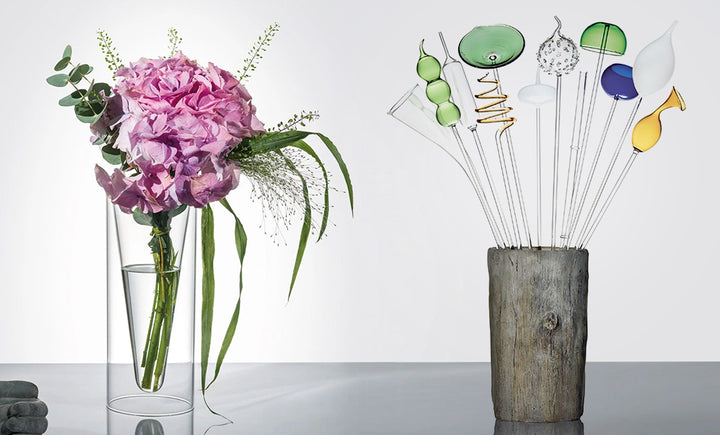
Natalìa: The Lightness of a Line
Natalìa naturally enhances the vertical movement of flowers.
A flowering branch, a long stem, or a single hydrangea becomes the focal point of a refined arrangement where glass and nature exist in perfect balance.
Tubular: Essential Forms for Contemporary Interiors
With its slender silhouette, Tubular highlights the natural direction of stems and branches.
It is an ideal glass vase for contemporary interiors and for those who appreciate the purity and restraint of ikebana.
Metaverso: Nature as Architecture
Metaverso expands the traditional concept of floral display.
Its modular structure allows more expressive compositions while preserving the balance and formal elegance that define ikebana.
Not simply a vase, but a landscape to inhabit.
Ikebana teaches us that beauty does not come from adding more. Often, it comes from removing what is unnecessary. Making space for light.
For material.
For gesture.
Tonk—and the collection of vases that accompany it—shares this same vision: a contemporary interpretation of Italian glass design, where a single flower is enough to transform a space.